Face2News/Indore
The situation surrounding organ donation in Madhya Pradesh remains a matter of concern. In 2023, 16,542 organ transplants were carried out across the country, but Madhya Pradesh accounted for just 1.6% of them. The picture is even more worrying when it comes to cadaveric organ donation, where organs are donated after a person’s death. Between January 2018 and June 2023, Madhya Pradesh recorded only 25 cadaveric organ donations, compared with 883 in Telangana and 713 in Tamil Nadu during the same period.
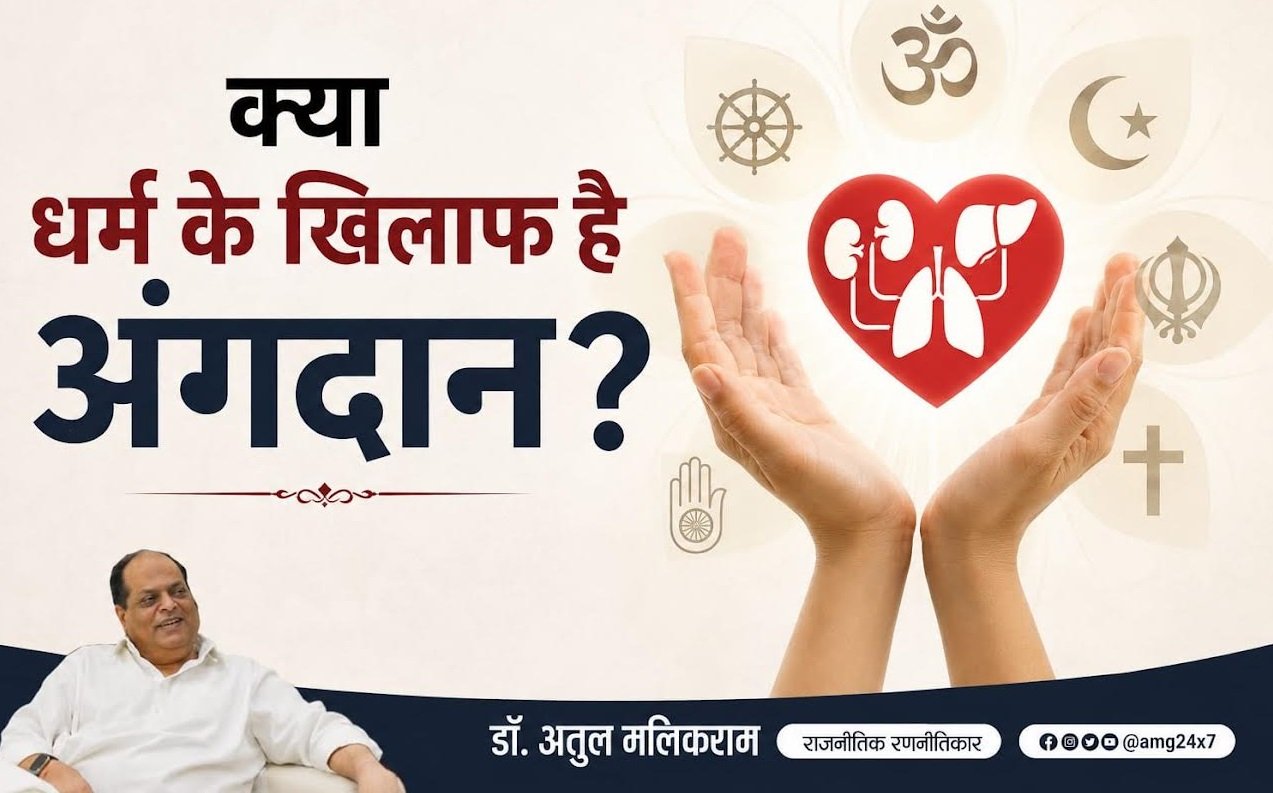
The challenge, however, is not limited to healthcare infrastructure or the availability of transplant facilities. Social beliefs, misconceptions, and concerns among families often play an equally important role, with some families reconsidering or withdrawing their consent for organ donation at the last moment. One question that needs to be addressed is whether organ donation is really against any religion. Available religious guidance and government information suggest otherwise. The Delhi Health Department, Government of India, has clarified that major religions do not oppose organ donation. This makes it important to separate religious beliefs from misconceptions and create greater awareness so that more families can make informed decisions about giving the gift of life.
In Hindu philosophy, the concept of Daan is not limited to monetary donations; rather, it entails contributing to the welfare of others according to one’s capacity. It is due to this broad concept of Daan that organ donation is considered compatible with Hindu beliefs. The Hindu perspective views the soul as distinct from the body and regards death as merely one stage in the cycle of life. Consequently, organ donation after death is not religiously viewed as an impediment to the soul’s journey. Religious guidelines regarding organ donation in Hinduism also align the practice with the spirit of saving lives. The legend of Sage Dadhichi is frequently cited in this context; he sacrificed even his own bones for the greater good.
Meanwhile, organ donation in Islam is more complex. It would be inaccurate to describe it as universally permissible or impermissible in every situation. Islamic scholars have different views on aspects such as the medical definition of death and the sanctity of the deceased’s body. However, many contemporary Islamic scholars and institutions permit organ donation when its purpose is to save lives, subject to certain conditions. These conditions generally include voluntary consent, ensuring the donor’s safety, prohibiting the buying and selling of organs, and avoiding harm to any individual. Therefore, the message within the Muslim community should be clear: while there is an ongoing religious discussion around organ donation, simply dismissing it as “against religion” is factually incorrect.
Furthermore, the core tenet of the Sikh tradition is rooted in the service of humanity and the spirit of Sarbat da Bhala (the well-being of all). Selfless service—or Seva—holds a special place in the Sikh philosophy of life. Consequently, organ donation can be viewed as a contribution toward saving the life of someone in need. Official Sikh religious guidelines impose no prohibition on organ donation; indeed, saving a life is considered a supremely noble act. Similarly, love, compassion, and helping others are central teachings of Christianity. On this ethical basis, the Christian community generally accepts organ donation as an expression of selfless love and the preservation of human life. While the dignity of the body is important, the spirit of saving another person’s life is equally essential.
Meanwhile, Ahinsa (non-violence) is the paramount principle of Jainism. Thus, compassion and the desire to alleviate the suffering of a living being can serve as significant foundations for organ donation. However, within the Jain tradition, individual and religious perspectives regarding the body, violence, and death may vary. Therefore, it is more appropriate to view this matter as one guided by discernment and circumstances rather than by a uniform religious mandate. In broader religious discourse, Jainism is also recognized as a faith that holds positive views regarding organ donation.
In this context, it becomes evident that the greatest obstacle to organ donation is perhaps not a shortage of organs, but a lack of accurate information. A study found that uncertainties surrounding death, funeral rites, and religious beliefs influence decisions regarding organ donation in India. Therefore, organ donation initiatives in Madhya Pradesh cannot be treated merely as campaigns by the Health Department.
If temples, mosques, gurudwaras, churches, and Jain Sthanaks were to issue a unified message—affirming that organ donation is a pledge to save lives—the social impact could be far more profound. Ultimately, the question should not be about which part of our body remains with us after death; rather, it should be about how many lives can be saved because of us after we are gone. Religion shows us the path to human welfare, while science provides the means to make that welfare a reality. Perhaps Madhya Pradesh now needs to bring these two together to drive the statistics in a positive direction.
National
Trending
IT IS ESSENTIAL TO EXAMINE THE ROLE OF RELIGIOUS PERCEPTIONS BEHIND THE LOW RATES OF ORGAN DONATION IN MADHYA PRADESH: DR. ATUL MALIKRAM