Face2News/Ludhiana
Across Punjab, the fight against air pollution and climate change is increasingly being shaped by women working across sectors, from public health and education to civic leadership, research and sustainable mobility. As the state grapples with worsening air quality, water stress and climate-linked risks, women leaders in Ludhiana and Amritsar are raising awareness while helping drive practical climate solutions rooted in community action.
(MOREPIC1) In Amritsar, civic leaders including Indu Aurora, Nidhi Sindhwani, Shweta Mehra, and Dr. Amrita Rana have emerged as important voices linking environmental action with public health and urban sustainability. By bringing together citizen groups, professional networks and institutions, they have helped frame air pollution not just as an environmental concern but as a pressing public health and governance challenge.
Dr. Amrita Rana, President of the Indian Medical Association in Amritsar, has consistently highlighted the medical consequences of deteriorating air quality, particularly the growing burden of respiratory and cardiovascular diseases. By introducing clinical and public health evidence into civic discussions on pollution, she has strengthened the case that clean air and climate action are essential for protecting human health.
At the community level, Indu Aurora, Nidhi Sindhwani and Shweta Mehra have been mobilising public engagement around environmental issues while advocating practical urban climate solutions. Their work has focused on building awareness about the links between everyday urban practices — waste, mobility, energy use and consumption — and their impact on air quality and climate.
Working with networks and women’s groups such as Clean Air Punjab and Saanjh Punjab, they have supported the expansion of women-led Pink Auto services in Amritsar, particularly the transition toward electric Pink Autos under the RAAHI scheme, where women beneficiaries received a 90 percent subsidy for electric autos. For women like Sonia, one of Amritsar’s Pink Auto drivers, the scheme has created a pathway to both economic independence and climate action.
These efforts have also intersected with civic initiatives such as Chalo Amritsar, a city-wide campaign led by Samita Kaur from Vatrukh organisation, encouraging citizen participation in making the city cleaner, greener and more sustainable.
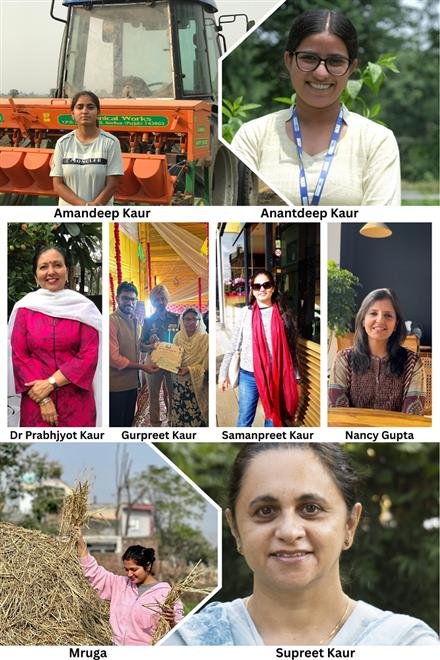
Another important voice in Punjab’s environmental movement is Supreet Kaur, who has been working through EcoSikh to promote community-driven climate solutions, including the creation of Miyawaki mini forests that help restore urban green cover and improve local air quality.
The scientific backbone of Punjab’s climate response lies in institutions such as Punjab Agricultural University, Ludhiana. Scientists like Dr. Prabhjyot Kaur, Principal Scientist in the Department of Climate Change and Agricultural Meteorology, are examining how climate variability is affecting agricultural productivity and rural livelihoods, while researchers such as Dr. Samanpreet Kaur and Anantdeep Kaur are studying groundwater sustainability, irrigation patterns and the impact of weather variability on crops.
A strong youth-led momentum is also emerging from the AirCare Centre at Khalsa College for Women, coordinated by Dr. Kumari Sita. Young fellows Kiranjot Kaur, Manreet Kaur, Kawalpreet Kaur, Hargun Kaur, Nandani, Avkirat Kaur and Gurleen Kaur are working on community outreach, farmer engagement and awareness campaigns on sustainable practices.
Across Punjab’s agricultural and entrepreneurial landscape, women are also shaping climate solutions. Gurpreet Kaur is promoting value addition in agriculture, Mruga, founder of Earth & Algorithms and User Design Labs, is exploring eco-friendly construction materials using agricultural residues, while Nancy Gupta, founder of Papernest, is producing tree-free handmade paper using garment and agricultural waste.
Young woman farmer Amandeep Kaur from Sangrur says, “When we burn our fields, we are not just burning crop residue—we are destroying biodiversity. Even insects have families and ecosystems that deserve our respect.”
As Punjab confronts the growing realities of climate change — from air pollution and stubble burning to floods and water stress — these women are quietly redefining leadership. From laboratories and farms to city streets and community networks, they are turning ideas into action and helping shape a cleaner and more resilient future.