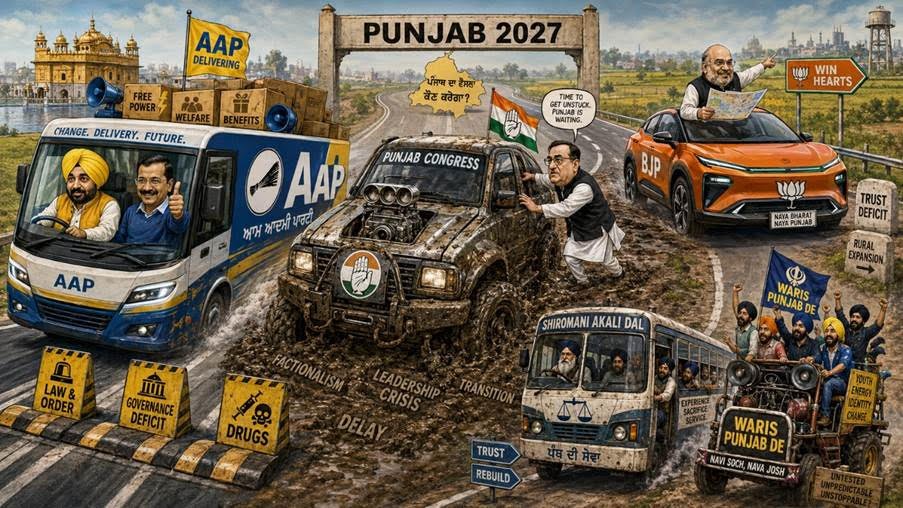
 AAP has started early, BJP has a map, Akali Dal is repairing its old bus, Waris Punjab De is a new jugaad ride, while Congress still has the biggest engine.
Gurpartap Singh Mann
Punjab’s next Assembly election may be few months away, and the road has already opened and the vehicles are revving up for the race.
AAP has started early. BJP has unfolded its route map. The Akali Dal is trying to restart an old vehicle that once dominated Punjab’s political highways. Waris Punjab De has entered like a new jugaad machine, noisy, emotional and capable of pulling young passengers from the old Panthic bus. Congress has the biggest engine of all, but it is still stuck in mud created by its own puddling.
That is the real shape of Punjab 2027.
This election will not be a simple two party contest. Punjab is moving towards a five cornered battlefield where even 20 to 25 per cent vote share may become decisive in several seats. In such an election, the party that is organised, disciplined and clear can convert a modest vote share into seats. The party that is divided may waste a larger vote share and still lose.
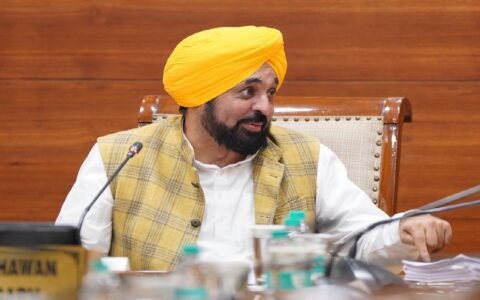
AAP has the first advantage because its vehicle has already started. Arvind Kejriwal has declared Bhagwant Mann as the chief ministerial face. This gives AAP workers a driver, voters a reference point and opponents a clear target. In politics, clarity itself is power.
AAP’s vehicle is not new anymore. It has been on Punjab’s roads for nearly a full term. It has gathered passengers through welfare and freebies. Free power, health schemes and direct benefits have given it a cushion among voters at the lower end of the electoral pyramid. These are not small things in a state where ordinary households are under pressure. Benefits create memory. Memory creates votes.
But the AAP vehicle also has visible weaknesses. Its suspension will be tested on the speed breakers of law and order, drugs, unemployment, fiscal stress and governance deficit. A vehicle can run on freebies for some distance, but not indefinitely. At some point, roads, policing, investment, industry, jobs and administrative credibility matter. AAP’s challenge is to show that it is not merely distributing fuel vouchers, but also repairing the road.
Still, AAP has done one thing right: it has avoided confusion over leadership. Its driver is named. Its passengers know who is at the wheel. And he has so far driven it quite well on the road full of economic pot holes.
BJP is a different vehicle. For decades in Punjab, it travelled mostly as a passenger in the Akali Dal bus, comfortable in urban seats, cautious on rural roads and rarely testing its own full engine. That phase appears to be ending. Amit Shah has told Punjab BJP leaders, once again, to prepare to go alone on all 117 seats. More importantly, he has identified the real road to power in Punjab: win the hearts of Punjabis.
That instruction is politically significant. BJP cannot win Punjab only through booth management, central schemes or national slogans. Punjab is not a state that can be captured by remote control. It has pride, wounds, memory, faith, agriculture, federal anxieties and a border state consciousness. To win Punjab, BJP must first win trust.
The BJP today resembles an electric vehicle (EV) trying to enter a market still emotionally attached to diesel tractors and old rural machines. It is soundless, organised, technology driven and backed by a powerful central battery. It has a dedicated high command, a clear objective and the discipline to keep moving even when others mock its chances.
But like an EV in rural Punjab, BJP still faces range anxiety. Its charging network is weak in villages. Its rural acceptability remains limited. Among sections of Sikhs and farmers, a trust deficit persists. It must explain where it stands on Punjab’s federal demands, river waters, Chandigarh, border district revival, MSP anxieties, trade routes and agriculture. If it cannot build emotional charging stations in rural Punjab, its battery may perform well in cities but run low in the countryside.
Yet BJP’s advantage is focus. It knows the obstacle. It knows trust is the barrier. It knows hearts must be won before seats can be counted. That clarity is a political asset.
The Akali Dal is the old Punjab roadways bus of state politics. For decades, it knew every rural road, every village stop, every Panthic route and every loyal passenger. It once carried farmers, religious sentiment, rural elites, traditional Sikh voters and local networks. Its conductor knew who would board at which stop.
That bus has not disappeared. It still has loyal passengers. It still has old mechanics. It still has route memory. But people are hesitant to board it again because of the driver’s decisions in the past. The paint has faded, the engine has aged and the moral authority that once powered Akali politics has weakened.
The Akali Dal’s challenge is not merely electoral. It is moral and generational. It must convince voters that it is not simply seeking restoration of an old order. It must show that it has understood why passengers got down in the first place. It must rebuild trust before it can rebuild vote share.
The conductor may still be calling out, “Chandigarh, Chandigarh,” from Moga, Muktsar, Bathinda and Majha. But passengers now have options. Some are trying AAP’s welfare bus. Some are watching BJP’s new EV. Some are drawn to the emotional noise of new Panthic vehicles. The Akali Dal can remain relevant, but unless it becomes credible again, it may not become decisive.
Waris Punjab De is the new jugaad vehicle in this election landscape. It is not yet a fully tested electoral machine. It may not have a complete road permit, strong tyres, tested brakes or a full route map. But it has one thing old vehicles often lose: emotional energy.
It has caught the imagination of a section of Sikh youth who feel alienated from traditional parties. Its appeal is identity driven, emotional and anti establishment. In Punjab, such currents must be watched carefully. They may not immediately become seats, but they can shape mood, language and pressure. They can pull passengers away from the Akali Dal bus, and even AAP, and disturb old Panthic arithmetic.
The challenge for WPD is to move from sentiment to structure, from attraction to organisation, from anger to programme. Youth attention is not the same as electoral durability. A jugaad vehicle may attract a crowd, but to complete a long journey it needs steering, brakes, discipline and direction.
And then there is Congress.
Congress has the biggest engine in Punjab politics. No other party has the same combination of historic reach, local leadership, rural and urban presence, governance memory and cross regional base. In many constituencies, Congress still has a deeper foundation than its rivals. It has the horsepower to compete seriously across Punjab.
But the engine is misfiring.
Punjab Congress resembles a powerful 4×4 stuck in political mud, because the 4×4 lever is yet to be engaged by the High Command. The mud is not entirely natural. Much of it has been created by the vehicle’s own wheels spinning without direction. Since Captain Amarinder Singh’s removal in September 2021, the party has been searching for a new centre of gravity. Whether one admired Captain or opposed him, he gave the party an accepted centre of gravity for nearly two decades. When he left, Congress removed not only a chief minister, but also the structure around which the Punjab unit had functioned.
That structure was never rebuilt.
The Navjot Sidhu experiment generated too much noise but resulted in engine seize . The Channi experiment carried symbolism but came too late. The 2022 defeat should have produced a hard reset. Instead, Congress entered a long phase of temporary arrangements, internal balancing and Delhi interventions.
Today, Congress has leaders. Partap Singh Bajwa has immense experience. Charanjit Singh Channi has social appeal and maximum popularity. Amrinder Singh Raja Warring has energy. Pargat Singh, Sukhjinder Randhawa, Rana Gurjit Singh, have influence. But leadership is not the same as authority. Every leader has supporters. Every camp has grievances. Every setback becomes ammunition. Every strategy meeting risks becoming a contest over future chairs. Driver has to be one.
Someone joked that the CM’s chair in Punjab Congress should be replaced by a seven seater sofa. It is a joke, but also a diagnosis. Ambition is normal in politics. Undisciplined ambition is fatal.
The appointment of Ajay Maken, Meenakshi Natarajan and Bhajan Lal Jatav as observers is therefore not routine. It is an attempt to check whether the 4×4 can still be engaged. Maken may help pull the vehicle out. But he cannot do it if those sitting inside keep pressing different pedals.
This is why Congress must act quickly. Anti incumbency against AAP will not automatically return voters to Congress. Anti incumbency is not a taxi that drops passengers at the Congress office. Discontent creates opportunity. It does not create mandate.
Punjab faces agricultural stagnation, groundwater depletion, industrial decline, youth migration, drugs, fiscal stress, border district anxieties and unresolved federal questions. Congress should have been naturally placed to lead this conversation. It has governance experience and leaders who know Punjab’s institutions. It has repeatedly won Punjab despite difficult historical burdens because voters trusted its local leadership.
That trust must now be rebuilt.
The road to 2027 is crowded. AAP has a running vehicle and named driver. BJP has a map, battery and central command, but must build trust in rural Punjab. The Akali Dal has an old bus with loyal passengers, but must repair credibility. WPD has a new jugaad vehicle that excites some youth, but must prove it can complete the journey.
Congress still has the biggest engine. But the biggest engine is useless if the vehicle remains stuck in its own mud.
And the race is just for 25 Miles (25% vote share) (The writer is an ex PPSC member)