Face2News/Chandigarh
In light of the upcoming 75th anniversary of Constitution Day (November 26, 1949), a meeting was held on October 26, 2024, at Central Singh Sabha Bhawan, Sector 28-A, Chandigarh. Sikh and Muslim representatives gathered to discuss the pressing concerns and challenges facing their communities in India today.
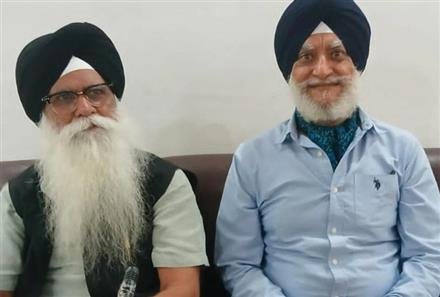
(MOREPIC1) The event was facilitated by All India Peace Mission President, Daya Singh, and Labbo Luab, who highlighted the importance of solidarity, mutual understanding, and safeguarding constitutional rights.
In today’s divided climate, where social fabric is increasingly strained, open dialogue between communities is crucial. The All India Peace Mission believes that isolating any community hinders national progress. The meeting emphasized the need for conversation and unity over division, as an essential step toward a truly inclusive democracy.
Historical and Current Context
For over 40 years, certain political ideologies have fostered narratives portraying communities such as Sikhs and Muslims as separatists and terrorists, leading to incidents like the 1984 Sikh genocide and recurring Hindu-Muslim riots. These events are seen as failures not only of the society but also of the Constitution in protecting its citizens. The unchecked violence and discrimination faced by minority communities, including the recent spate of bulldozing homes and businesses without legal process, reveal a growing marginalization in political and social spheres.
The All India Peace Mission expressed concern that this exclusion extends beyond borders, with countries like Canada, the US, the UK, and Australia adopting policies that strain relations with Sikh and Muslim communities globally. This isolation, both domestically and internationally, highlights the need for a platform dedicated to protecting the constitutional rights of minorities and fostering inter-community dialogue.
Caste and Religious Identity
The reservation policy for Scheduled Castes and Scheduled Tribes (SC/ST) within the Sikh community has introduced caste distinctions in a community that traditionally rejects casteism. Sikh leaders voiced concerns over being categorized under Article 25 of the Indian Constitution, which does not acknowledge Sikhism as a separate faith from Hinduism. There was a call for special constitutional provisions for Sikhs, Muslims, Christians, and even some classes of Hindus, facing inequality & exploitations even in existing reservation policies.
Political and Cultural Challenges
The influence of the RSS in Punjab was highlighted as an attempt to weaken Sikh leadership. The Akali Dal, a party with a 100-year legacy of fighting for India’s independence, now struggles to retain its political foothold, even in local elections. It raises questions on whether external pressures are diminishing the influence of Sikh institutions, including the Shiromani Gurudwara Parbandhak Committee (SGPC).
Concerns were also raised about recent statements made by prominent Sikh leaders, calling for adherence to the Sikh Rehat Maryada. Disputes within Sikh leadership, especially concerning the actions of certain Jathedars, were discussed as factors leading to the current situation faced by the Sikh community.
Conclusion
This gathering marked a significant step in addressing the need for minority rights, open dialogue, and inter-community solidarity. The questions raised demand answers from leaders and the community to prevent further marginalization. The voices of Sikh and Muslim communities in Punjab and across India must be recognized to restore balance and strength to India's democracy.