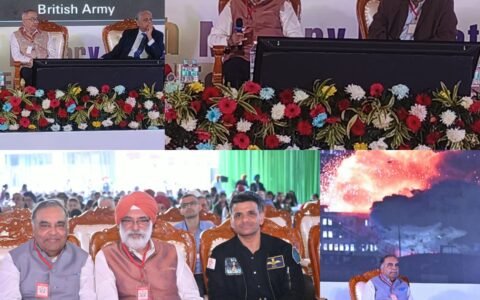
 MILITARY LITERATURE FESTIVAL 2026: Ukraine, space warfare, West Asia and India’s strategic ambitions dominate high-level military and diplomatic deliberations
Face2News/Chandigarh
The second day of the Military Literature Festival 2026 brought together an eminent gathering of diplomats, senior military commanders, strategic affairs experts and India’s space leadership to examine the geopolitical shifts and technological transformations redefining global security.
Five high-level panel discussions addressed India’s strategic position in a multipolar world, lessons from the Russia–Ukraine war, human spaceflight, the militarisation of outer space and the strategic and energy-security implications of the West Asian conflict.
India’s Strategic Position in a Changing World
Moderated by Ambassador Gurjeet Singh, Panel 1, Turbulent World Order – Where India Stands, featured Ambassador Yashvardhan Kumar Sinha and strategic affairs expert Sushant Sareen.
The discussion examined India’s strategic autonomy amid intensifying US–China competition. The speakers highlighted indigenous manufacturing, technological self-reliance, artificial intelligence, semiconductor capabilities, economic competitiveness and development diplomacy as essential to India’s emergence as an independent global pole.
Ukraine and the Future of Warfare
Panel 2, Relevance of Russia–Ukraine War to the Indian Subcontinent, moderated by Brigadier Anshuman Narang, featured Major General John Kendall, Lieutenant General Raj Shukla (Retd.) and Ambassador Venkatesh Verma.
Drawing on the Ukraine battlefield, the discussion examined the transformation of warfare through drones, electronic warfare, autonomous systems, artificial intelligence, cyber operations and space-based intelligence. The panellists stressed the importance of technological adaptation, industrial resilience and indigenous defence innovation for India’s future preparedness.
India’s Human Spaceflight Ambitions
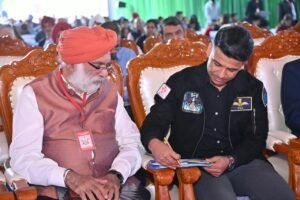
A major highlight was Panel 3, From Fighter Cockpit to Spacecraft – India’s New Frontier in Air and Space Power, featuring Group Captain Shubhanshu Shukla.
Sharing first-hand insights from his historic mission aboard the International Space Station, he discussed astronaut training, microgravity, scientific experimentation and the demands of human spaceflight. He outlined India’s ambitions through the Gaganyaan programme, the proposed Bharatiya Antariksh Station and the vision of an Indian astronaut reaching the Moon by 2040.
His observation, “You become comfortable in being uncomfortable,” captured the discipline, resilience and determination underpinning India’s space ambitions. He also encouraged young people to pursue opportunities in space science and exploration.
Space Warfare and the New Security Frontier
Panel 4, Space Warfare – You Can Run But Not Hide, moderated by Maj Gen Amritpal Singh, featured Lt Gen Kuldip Singh Sindhu, Maj Gen Neeraj Bali and Maj Gen Harvijay Singh.
The discussion examined the growing militarisation of outer space, satellite vulnerabilities, counter-space capabilities, electronic and optical disruption, directed-energy technologies and proximity operations. China’s expanding counter-space capabilities and their implications for India’s security also received attention.
The panellists underscored the need for resilient satellite infrastructure, indigenous capabilities and effective protection of critical space assets as space becomes an increasingly important domain of national defence.
West Asia: Conflict, Geopolitical Realignment and Energy Security
Panel 5, West Asia War, Geopolitical Instability and the Energy Crisis, featured Dr. Deepika Saraswat and Ambassador Yashvardhan Kumar Sinha, with Maj Gen Amritpal Singh as moderator.
Dr. Saraswat examined the erosion of expectations of regional stability following the Hamas attacks of 7 October 2023, analysing the Israel–Iran confrontation, unresolved regional conflicts and their implications for the wider security architecture.
Ambassador Sinha, drawing on more than 37 years of diplomatic experience, including postings in Cairo, Riyadh and Abu Dhabi and service as India’s Consul General in Dubai, traced the historical roots of West Asian rivalries to the Sunni–Shia schism and the Battle of Karbala. He highlighted the continuing influence of historical grievances, regional alignments and external powers.
Maj Gen Amritpal Singh broadened the discussion to changing international alliances, China’s growing influence, Africa’s emergence as an increasingly significant energy and geopolitical actor, and uncertainty surrounding US foreign policy and NATO cohesion.
The discussion highlighted the wider consequences of West Asian instability for global energy markets, international relations and India’s strategic interests.
Military Heritage and the Next Generation
Adding a distinctive educational dimension, “Saga of Courage and Bravery,” presented by Defence Studies students of Government College, Sector 11, Chandigarh, brought India’s military heritage, valour and traditions of sacrifice into focus.
The festival also featured the Clarion Call Theatre’s war films, cultural performances, weapons display, military paintings, philately and vintage automobiles. Interactive Samvaad sessions enabled visitors to engage directly with Param Vir Chakra and Maha Vir Chakra awardees.
Strategic Dialogue for a Changing World
Day 2 reinforced the interconnected nature of contemporary security challenges, where military capability, technological innovation, diplomacy, economic resilience and energy security increasingly shape national power.
The Military Literature Festival continues to provide an important national platform for informed engagement between the armed forces, diplomatic community, strategic thinkers, academia and the next generation