 BJP AND SAD NEED EACH OTHER, BUT THE OLD COALITION CANNOT SIMPLY BE REVIVED. A BROADER ARRANGEMENT ACCOMMODATING SAD (PUNAR SURJIT) CAN CHANGE PUNJAB’S POLITICAL SPECTRUM, GIVE AAP A SERIOUS CHALLENGE—AND CONGRESS A MUCH-NEEDED SHAKE-UP CALL.
By Gurpartap Singh Mann
In December 2025, I wrote that an alliance between BJP and a Panthic party was socially important for Punjab. My argument was not based on votes alone. BJP, despite its growing support, had failed to cross Punjab’s stubborn emotional barrier. It needed a credible Panthic bridge. It still does.
Eight months later, alliance discussions are no longer just drawing-room gossip.
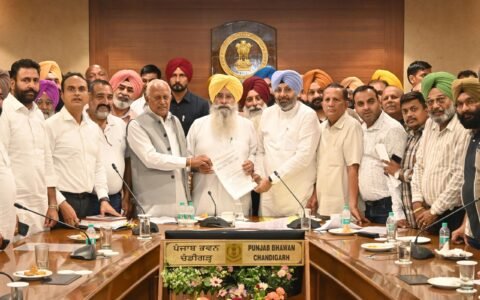
Sukhbir Singh Badal met Prime Minister Narendra Modi on August 7, their first political meeting since SAD left the NDA in 2020. Harsimrat Kaur Badal and Bikram Singh Majithia then spoke in favour of a reunion. BJP continues to publicly claim that it will contest all 117 seats. But The Indian Express reports that backroom talks with the Badal-led SAD are continuing.
Other formulas are also on the table. The Tribune reports that SAD (Punar Surjit) leaders are being considered in a broader BJP-Akali arrangement. Another possibility involves BJP, SAD (Punar Surjit), BSP and smaller Panthic groups, while keeping the Badals out.
Nothing is final. Hard bargaining is going on.
The arithmetic explains why. In the 2024 Lok Sabha election, BJP received around 18.5 per cent of Punjab’s vote but won no seat. SAD received approximately 13.5 per cent and won only Bathinda. Together, nearly 32 per cent.
But in politics, one plus one can become two, three—or even one-and-half.
An internal assessment cited by The Tribune found that their combined votes would have put them ahead in 57 of Punjab’s 117 Assembly segments, just two short of a majority. Tempting figures. But votes cannot simply be added like numbers in an account book. The chemistry matters.
The old alliance worked because the two parties occupied separate spaces. BJP connected with urban Hindu voters. SAD mobilised rural Sikh voters. They complemented each other and rarely fought for the same vote.
That neat division is now broken. BJP fields Sikh candidates, has inducted several Akali leaders and wants seats earlier treated as SAD territory. Former Congress leaders such as Kewal Singh Dhillon and Ravneet Singh Bittu, who have spent years attacking the Badals, are now important BJP faces. H S Phoolka, another fierce critic of the Badal family, is also in BJP.
Putting everyone on one stage is possible. Getting their voters to move together is much more difficult.
Will SAD’s Sikh voters support BJP candidates? Will BJP’s urban voters vote for Akalis? Will those who abandoned SAD over sacrilege and other painful controversies return merely because two leaders shake hands? These are not small questions.
Yet this difficulty does not weaken the case for an alliance. It shows why the old arrangement cannot be simply dusted, repainted and presented as new.
Despite Prime Minister Modi’s considerable efforts—the Kartarpur Corridor and national recognition of the martyrdom of Guru Tegh Bahadur Ji and the Sahibzadas—distrust of BJP survives among sections of rural Sikh society. Some came from the farmers’ agitation, some from relentless political messaging, and some is difficult to explain rationally. Fair or unfair, it exists.
A credible Panthic partner can give BJP the social and emotional acceptance that even a powerful election machinery cannot. It can dilute the accusation that BJP is “Sikh virodhi” and push this increasingly tired rhetoric back into hardline and diaspora corners.
There is also an uncomfortable rise in anti-Hindu language among a small section of Sikh hardliners. Thankfully, it is not the wider Sikh mood. Nor do we see comparable anti-Sikh hostility among Punjab’s Hindus. This ugly rhetoric should not be exaggerated, but ignoring it will also be foolish. It needs careful political recalibration. Very careful.
The Badal-led SAD cannot be wished away. It still has cadre, organisation, the traditional election symbol, a Lok Sabha MP and a visible vote. But an alliance confined to BJP and the Badals would leave the Panthic split wide open.
SAD (Punar Surjit) must therefore be accommodated with dignity, not as an afterthought. A forced merger is neither realistic nor required. BJP can reach separate but coordinated understandings with both Akali factions, allowing them to retain their identities under a common Punjab agenda.
BJP cannot return to the old formula of only 23 seats. Its claim over 45–50 seats has some logic. But a demand for 70–80 seats would make its Panthic partners helpless appendages. That is not partnership. It may actually deepen the very emotional resistance that the alliance is meant to reduce.
Punjab also badly needs a real political contest. AAP came to power with 92 seats, a massive and almost unchallenged majority. Congress had similarly won 77 seats in 2017. Such lopsided mandates can slowly disconnect governments from ordinary people. Leaders start behaving like superheroes. The Assembly becomes a formality and the police risks becoming a partisan political instrument.
No government should treat a divided opposition as permanent public approval and move like a powerful road roller. Congress remains a major force, but a broad BJP–SAD–Punar Surjit arrangement would rearrange the entire political field, challenge AAP and give Congress a sharp wake-up call.
Punjab needs a balanced Vidhan Sabha. A government strong enough to govern, yes—but an opposition equally strong enough to question it, restrain it and stop the misuse of power. That balance is not instability. That balance is democracy. (The writer is Ex -Member PPSC)