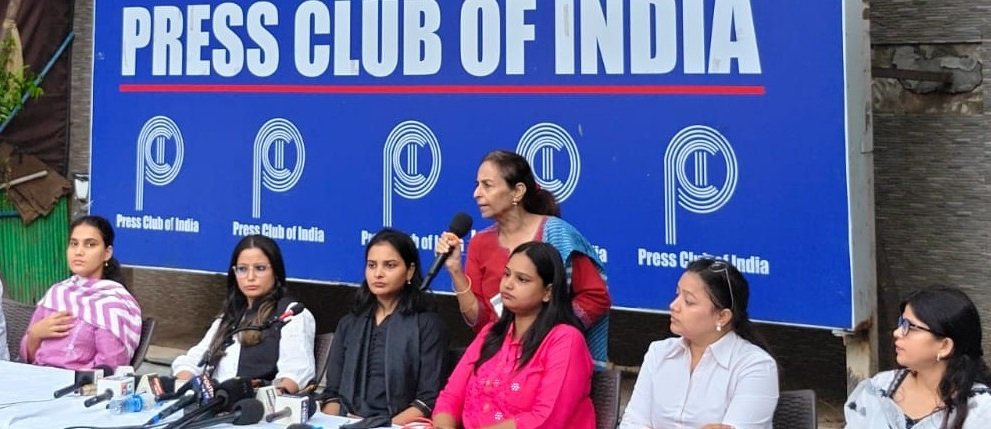
SIX ANGRY YOUNG WOMEN FACED THE CAMERAS AT THE PRESS CLUB IN DELHI, THEY WERE NOT ACTIVISTS, THEY WERE JOURNALISTS DETERMINED TO BE HEARD BY THEIR PEERS AND GOVERNMENTS.
Face2News/New Delhi
The DUJ expresses its solidarity and complete support for the struggles of these courageous media women. Pooja Mathur set the tone at the meeting held by the Press Club of India, the Delhi Union of Journalists and the Network of Women in Media to protest attacks on women journalists.
Mathur spoke boldly of how she has been targetted by the UP government for her coverage of the bulldozing of a Saharanpur masjid on Sept. 6. Mathur said she was the first to report the demolition on her YouTube channel Red Chili Live. She interviewed the Imam of the mosque and took a video of the rubble. After that she received messages demanding that she delete the videos, followed by threats when she refused. An FIR has been filed against her.
Mathur said courageously, “I was doing my job. I àm not afraid. I will not cry, I will make them cry.” She also pointed out that women journalists like her are the voice and the inspiration of countless other women who dare not step out of home and raise their own voices against oppression.
Mathur also said to the big gathering present, “Do not dismiss us as just youtubers. We are serious journalists, we are qualified, we do our research before we go online.”
Divya Srivastava spoke of how she was targetted after she dared to speak at a ‘press conference’ held by UP Chief Minister Yogi Adityanath on Sept 12. The CM spoke but took no questions. When Divya loudly called him out, asking him to hear her question, he simply walked away. This smàll incident was blown out of proportion with some fellow journalists warning her to go into hiding as she would now be under fire. She was trolled heavily, with threats, gaalis and allegations that she had been sent by a rival political party to ask questions.
“Why should I hide, journalism is not a crime,” Mathur said.
She said her job at a channel was now insecure as the channel owners were afraid of the backlash.
Bindu Romi Gujjar and Monika Singh, both independent journalists based in Delhi, were among the first to reach Balaghat in Madhya Pradesh after several Baiga tribal children died of disease in August 2026. They interviewed parents and relatives of the children.
Gujjar described the trauma of witnessing funeral rites. She said there was only one primary health centre for 25 villages and the nearest hospital is 130 km away. No ambulance is available. She said that the deaths were caused by malaria, a treatable disease. She asked why no malaria vaccines are provided in malaria prone areas.
Singh described conditions in the government hospital where 3 or 4 children were lying in each bed.
The journalists’ documentation of 30 deaths, backed by Aadhar cards and other evidence, embarrassed the local administration which claimed there were only eight deaths. The reporters were shadowed for several days and threatened. The Superintendent of Police wanted them to meet him. They did not go. Two policemen came to their hotel room at 2 a.m. at night, she said. They began to fear for their lives. Eventually they left the hotel in the night and returned to Delhi.
Singh spoke of the conditions in the Baiga villages where there are no facilities, not even clean drinking water. She spoke of the hospital which the District Magistrate, she said, visited several days after the first deaths. She claimed that 34 children were discharged the day before his visit, more beds were supplied, bed linen changed and the entire hospital disinfected. She said the journalists were accused of being Muslim and a doctor at the hospital openly displayed bias.
On Sept 6 the social media accounts of Bindu Gurjar, Lok Singh and Monika were suspended. Monika’s account is still suspended. “We are independent journalists,” she said, “how will we earn and continue to work if accounts are suspended?”
Impassioned testimonies came from Shaheen Khan and Nafeesa Khan of 4 PM News, who were picked up by Saket police on Sept 3, 2026, while standing on the roadside to report the visit of Home Minister Amit Shah and Chief Minister Rekha Gupta to Max Hospital to inaugurate a new wing.
Nafeesa described in detail their detention at Saket police station and the trauma of being beaten with fists and a lathi by a woman inspector. She said she began to fear for her life after the inspector learnt they were Muslim and began to beat them more viciously. The SHO, she said, had ordered the beating and other police personnel were complicit.
Shaheen said that after the incident became public senior policemen later apologised and admitted there had been a mistake. However, she said, the FIR eventually registered names of only two police personnel, although they have filed a complaint against several personnel. She urged journalists to take up the issue and ensure justice.
The meeting was also addressed by PCI President Sangeeta Baruah Pisharoty, Secretary General Afzal Imam, DUJ President Sujata Madhok, Divya Arya of the Network of Women Journalists in India, journalist Khushbu Akhtar and Caravan Editor Hartosh Singh Bal who expressed solidarity with the media women and applauded them for their courage in speaking out.
National
Trending
WOMEN JOURNOS PROTEST ATTACKS