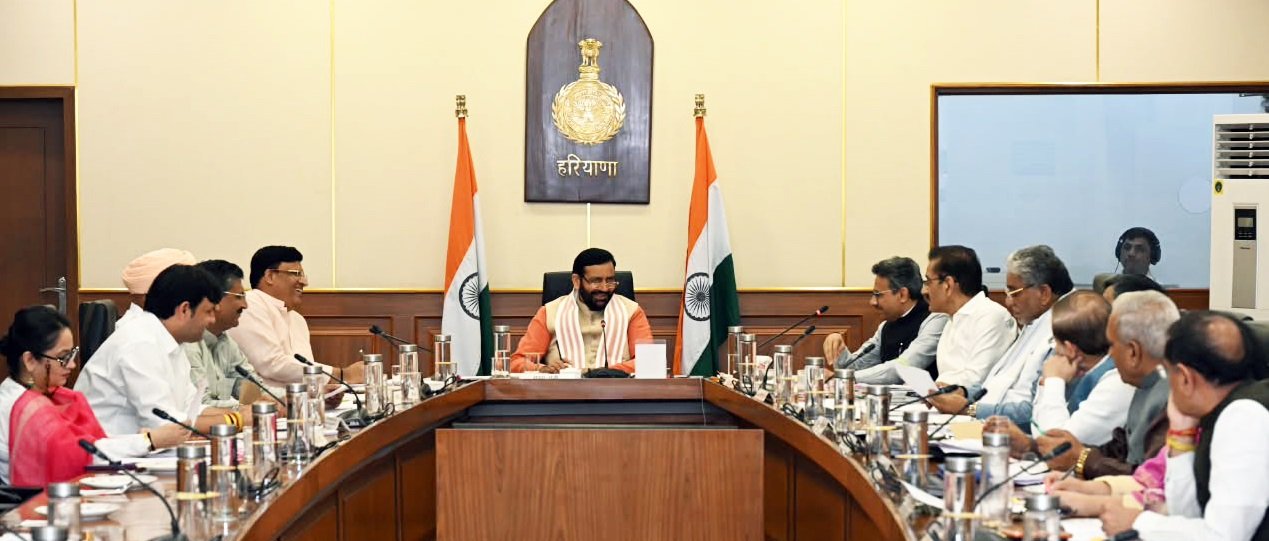
CABINET APPROVES HARYANA REGISTRATION AND REGULATION OF TRAVEL AGENTS RULES, 2026; SEPARATE REGISTRATION MANDATORY FOR EACH SERVICE CATEGORY, CITIZENS CAN VERIFY AUTHENTICITY OF TRAVEL AGENTS’ REGISTRATION BY SCANNING QR CODES
Face2News/Chandigarh
The Haryana Government is set to introduce an effective regulatory mechanism to protect the state’s youth from unscrupulous individuals who deceive them with promises of overseas employment and better career prospects and facilitate illegal migration abroad. In this direction, the Cabinet, which met here today under the chairmanship of Chief Minister Sh. Nayab Singh Saini, approved the Haryana Registration and Regulation of Travel Agents Rules, 2026, under the Haryana Registration and Regulation of Travel Agents Act, 2025.
The primary objective of these rules is to safeguard the state’s youth against fraudulent travel agents, illegal overseas recruitment, human trafficking and unlawful activities such as the “donkey route”, while ensuring transparency and accountability in the travel agency business.
Under the new rules, registration will be mandatory for all new and existing travel agents operating in the state. Separate registration will be required for every new office or branch. Similarly, separate registration will be mandatory for each service category, including passport services, tour and travel agency services, study visa consultancy and ticketing services.
To ensure financial accountability, a registration fee of Rs. 5,000 has been prescribed for each service category. Police verification of every applicant will be mandatory before registration to ensure proper background checks of individuals engaged in the business.
Upon receipt of the police verification report, the competent authority will issue the registration certificate within 30 days. The certificate will remain valid for three years. To facilitate public convenience and ensure transparency, travel agents will be issued digital registration certificates equipped with QR codes. Citizens will be able to scan these codes to verify the authenticity and validity of the concerned agent’s registration.
In addition, district-wise lists of registered travel agents, along with their registration certificates, will be made available on the Antyodaya SARAL Portal as well as the official websites of the Home Department and Police Department, enabling citizens to easily verify the legitimacy of travel agents.
As per the rules, every registered travel agent will be required to display the registration number and the dates of issuance and expiry of the registration certificate both inside and outside their office. It will also be mandatory to mention the registration number in advertisements, on websites and on other online portals.
These rules will bring greater transparency to the functioning of travel agents and help protect young people from illegal overseas recruitment, human trafficking and other unlawful activities.
HARYANA CABINET APPROVES AMENDMENTS TO HARYANA PUBLIC SERVICE COMMISSION (STATE SERVICE GROUP-C) REGULATIONS, 2002 : Cabinet approved amendments to the Haryana Public Service Commission (State Service Group-C) Regulations, 2002, to incorporate newly created Group-C posts in the Commission and bring the existing provisions in line with the latest government rules and instructions.
The amendment will update the sanctioned strength of various Group-C posts in the Haryana Public Service Commission (HPSC), in view of the increasing workload of the Commission due to a rise in the number of examinations and other related functions.
As per the amended regulations, the total number of sanctioned Group-C posts in the Commission will be 85, including 15 newly created posts. These comprise one Section Officer, three Deputy Superintendents, one Personal Assistant, 25 Assistants, two Senior Scale Stenographers, two Junior Scale Stenographers, six Steno Typists, 13 Drivers, 29 Clerks, one Restorer and two Gestetner Operators.
The Cabinet-approved amendments also provide for changes in the eligibility conditions for appointment to these posts. The existing provisions relating to certain categories, including Tibetan refugees and persons of Indian origin migrating from Pakistan, Burma, Sri Lanka and certain East African countries, have been proposed to be omitted. The eligibility provisions will now be restricted to citizens of India and subjects of Nepal and Bhutan. However, the appointment of subjects of Nepal and Bhutan will be subject to the condition that an eligibility certificate has been issued by the Government.
Further, the provisions relating to disciplinary matters, appeals and other service-related matters under Regulation 13 will be aligned with the Haryana Civil Services (Punishment and Appeal) Rules, 2016, replacing the earlier reference to the Haryana Civil Services (Punishment and Appeal) Rules, 1987. The amendments will also specify the competent authorities in accordance with the applicable rules.
In another significant change, the existing requirement of Hindi up to Matric standard in Appendix-B of the regulations will be substituted with Hindi or Sanskrit as one of the subjects at Matric level or Hindi as one of the subjects in Higher Education.
Cabinet Approves Amendments to College Cadre Group C Service Rules : The Council of Ministers, approved amendments to the Haryana Educational College Cadre (Group C) Service Rules, 1986, revising qualifications for appointment to the post of Junior Lecture Assistant and updating other service provisions.The amended rules will be called the Haryana Educational College Cadre (Group C) Service (Amendment) Rules, 2026. They will come into force from the date of their publication in the Official Gazette.
Under the revised provisions, candidates seeking direct recruitment to the post of Junior Lecture Assistant must have passed 10+2 in the science stream with Physics, Chemistry and Mathematics (PCM) or Physics, Chemistry and Biology (PCB). They must also possess five years’ experience as a Laboratory Attendant in a recognised college. Hindi or Sanskrit as a subject at the matriculation level, or Hindi as a subject in higher education, will also be required.
For appointment by promotion, the prescribed qualifications will be 10+2 or its equivalent and five years’ experience as a Laboratory Attendant after regular appointment to the post.
The amendments prescribe an age limit of 18 to 42 years for direct recruitment, determined as on the last date for submission of applications to the Haryana Staff Selection Commission. Relaxation in the upper age limit will be admissible under the Haryana Civil Services (General) Rules, 2016.
As per the new Rules, the Commission may relax the experience requirement by up to 50 per cent where sufficient candidates with the requisite experience are unavailable against vacancies reserved for Deprived Scheduled Castes, Other Scheduled Castes, Backward Classes, Ex-Servicemen and Persons with Disabilities. Reasons for granting such relaxation must be recorded in writing.
The amended rules also update provisions relating to nationality, reservation and confirmation on satisfactory completion of probation. Indian citizens and subjects of Nepal or Bhutan will be eligible for appointment, with subjects of Nepal or Bhutan required to hold a certificate of eligibility issued by the Government.
Reservation and other concessions will continue to apply in accordance with State Government orders. The amendments also retain the Government’s authority to increase or reduce the number of posts or create new regular posts with different designations and pay scales.
Cabinet Approves Amendments to Transferable Development Rights Policy: Cabinet, which met under the chairmanship of Chief Minister Sh. Nayab Singh Saini here today, approved amendments to the policy for grant and utilisation of Transferable Development Rights (TDR), dated November 16, 2021, to address issues related to the valuation, transfer and utilisation of TDR certificates and facilitate the implementation of infrastructure development projects across the state.
The existing TDR policy provides for granting TDR certificates to landowners who surrender their land required for critical infrastructure development projects in favour of the Government. Such certificates enable landowners to monetise their development rights by selling them to developers or other users within the same Development Plan.
Under the amended policy, the formula for calculating the notional land for which a TDR certificate is issued will be revised. The calculation will be based on the weighted average collector rate applicable to the surrendered land as on the date of submission of the application, instead of the existing provision linked to the rate applicable on January 1 of the calendar year of application.
The Cabinet has also approved changes in the formula for calculating the notional land of the receiving site. The revised calculation will take into account the weighted average collector rate applicable to the receiving site as on the date of application submission on the basis of which the TDR certificate was granted.
Further, the collector rate notified by the Deputy Commissioner concerned and prevailing on the date of application submission will be considered for granting the TDR certificate, irrespective of the date on which it is eventually utilised.
The amendments also provide that the revised formula will apply to all pending applications for grant of utilisation certificates where no permission, including in-principle approval for utilisation of the TDR certificate, has been accorded.
In another significant change, TDR certificates issued under the policy will be valid for utilisation either in the same Development Plan or in any lower-potential Development Plan of the State, instead of being restricted only to the Development Plan in which they were originally issued. This provision is intended to facilitate cross-utilisation of TDR certificates and enable project proponents across Haryana to avail the benefits of the policy.
The amendments are aimed at addressing concerns regarding the declining value of TDR certificates over time, improving their utilisation and facilitating land assembly for critical infrastructure projects, including sector roads, green belts and other planned development works.
Cabinet Approves Revised Licence Renewal Provisions under New Integrated Licensing Policy-2022
The Haryana Cabinet, which met under the chairmanship of Chief Minister Sh. Nayab Singh Saini here today, approved an amendment to Clause 9.2 of the New Integrated Licensing Policy (NILP)-2022, revising the provisions governing completion of projects and renewal of licences.
Under the amended provision, projects shall be completed within five years. If a project is not completed within this period, its licence shall be renewed in accordance with Rule 13 of the Haryana Development and Regulation of Urban Areas Rules, 1976, upon payment of the applicable licence renewal fees.
The amendment brings licence renewal for NILP colonies on a par with group housing colonies. It replaces the existing provision requiring project completion within seven years, comprising an initial licence validity of five years and a two-year renewal, beyond which renewal required payment of 100 per cent of the licence fee. The revised provision will take effect from the date of final notification and will also apply to all existing licences.
Haryana Cabinet Approves Land Pooling Policy-2026; Landowners to Get 50 Per Cent of Saleable Area The Haryana Council of Ministers, which met under the chairmanship of Chief Minister Sh. Nayab Singh Saini here today, approved the Land Pooling Policy-2026, replacing the existing Land Pooling Policy-2022, to facilitate landowners’ participation in development projects.
Under the new policy, landowners will be offered 50 per cent of the total saleable area of the project as per the approved layout plan, while the remaining 50 per cent will be retained by the development organisation. The earlier provisions linking the landowners’ share to market value have been removed.
Within the landowners’ 50 per cent share, commercial sites will be offered according to the prescribed entitlement. The remaining area will be allotted as residential, industrial or institutional plots, depending on the purpose of the project.
The policy provides annual interim financial support of Rs. 1 lakh per acre, proportionate to the land contributed, for four years from the date of registration of the sale deed. If the amount is not transferred within 15days of the sale deed, the landowner will be entitled to simple interest at nine per cent per annum for the period of delay.
The project completion period has been reduced from five years to four years. The development organisation will be required to complete infrastructure facilities within four years from the date of final approval of the project, failing which the land will revert to the landowners.
The minimum sizes of developed plots to be offered to landowners have been fixed at 100 square metres for residential plots, 250 square metres for industrial plots and 500 square metres for institutional plots. The actual area allotted will be determined in proportion to the land contributed. Commercial plots in the form of kiosks or booths will be allotted, as applicable, where the land contribution exceeds 2,000 square metres.
Landowners contributing less than 999 square metres will receive monetary compensation under the Right to Fair Compensation and Transparency in Land Acquisition, Rehabilitation and Resettlement Act, 2013, or at the reserve price of the plot, whichever is higher.
Holders of Land Entitlement Certificates will be able to club their certificates and jointly apply for larger developed plots. The period for buyback of allotted plots by the development organisation has been extended from one year to three years.
The policy also fixes the land aggregator’s remuneration at 0.5 per cent of the collector rate for agricultural land in the concerned revenue estate. This remuneration will be borne by the development agency and paid after completion of the project’s sale deed process. Land pooling through e-Bhoomi has been excluded from the new policy.
Haryana
Trending
REGISTRATION OF TRAVEL AGENTS NOW MANDATORY IN HARYANA; CRACKDOWN ON FRAUD AND ILLEGAL OVERSEAS MIGRATION