NARROWING OF HEART VALVES IN THE ELDERLY CAN BE TREATED SAFELY WITHOUT SURGERY, DR BALI, 50 PATIENTS SUCCESSFULLY TREATED
(MOREPIC1)Face2News/Chandigarh
87 years old, Tara Chand (name changed), resident of Panchkula, had undergone a non-surgical procedure for aortic valve replacement for aortic stenosis (narrowing of heart valve between left-sided pumping chamber of the heart and aorta leading to the lesser blood supply to body) by Dr. Bali in the year 2024. He reminisced that he was rushed to the hospital in a critical situation. His hope for treatment was dim and yet today he has survived and stands as testimony to the successful procedure he underwent for relief of his critical life-threatening aortic stenosis.
Tara Chand is among more than 50 septa, octa, and nonagenarians spread across north India who because of non-surgical Transcutaneous aortic valve replacement have survived the critical aortic stenosis (narrowing of the aortic valve of the heart) without undergoing major surgery.
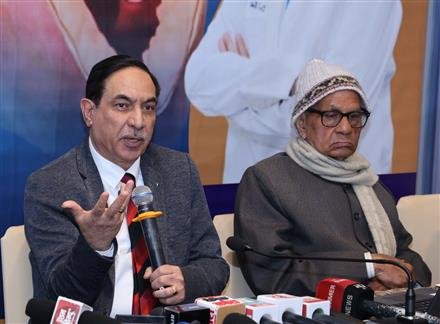
Flanked by his patients Dr HK Bali, Chairman of Cardiac Sciences Livasa Group of Hospitals said that such patients face severe obstruction to smooth blood flow from the left ventricle to the aorta, the artery that supplies blood to the entire body. Normally aortic valve allows unrestricted blood flow during the pumping phase of the cardiac cycle and prevents backflow during cardiac relaxation. Since aortic stenosis is mainly prevalent in elderly patients, they are at higher risk for surgical valve replacement as they commonly have multiple health issues such as chronic renal failure, sever lung disease, and previous stroke.
Dr Bali's patients underwent transcutaneous aortic valve replacement (TAVR) which is a non-invasive method of implanting the aortic valve. It is a non-surgical aortic valve replacement option known as TAVR that's a boon for heart patients with multiple problems including chronic renal failure, severe lung disease, previous stroke history, etc.
Initially, Transcutaneous aortic valve replacement was done only in those patients who were at high risk for surgical valve replacement. With increasing experience and availability of better valves, now, TAVR can be safely done in moderate and normal-risk elderly patients with severe aortic stenosis, said Dr. Bali
Dr Bali added aortic stenosis is on a steady rise in India particularly in elderly people and predominantly occurs because of age-related degeneration of the heart valve. Two percent of people above 80 years of age and four percent above 90 years have degenerative aortic stenosis.
In such conditions, TAVR has emerged as a very good, effective, and safe alternative to surgical aortic valve replacement in these people. TAVR is an entirely percutaneous procedure done under local anesthesia and the entire procedure is over in a couple of hours. The patient is ambulatory the next day and is discharged in 2 or 3 days.
Since starting more than seven years ago, Dr. Bali has performed over 50 TAVR procedures, the largest single-operator experience in the region and one of the largest in the country.
(SUBHEAD)He explained that during this period many patients who were critically sick and had no hope were successfully treated with TAVR. Five of the patients were above 85 years of age and three were above 90 years of age. Three patients who underwent successful TAVR were post-bypass patients. Dr. Bali said that with increasing experience, more patients are being identified with different clinical presentations than classical patients with critical stenosis. These patients can also be diagnosed correctly and successfully treated by TAVR.
He said now patients with severe left ventricular dysfunction and heart failure due to critical aortic stenosis were being recognized. Because of severe heart failure, these patients were difficult to diagnose earlier as classical clinical features are very subtle or completely absent in such patients
Echocardiography in these patients does not show severe gradients across the valve because of very weak heart muscle. Dr Bali said that with a better understanding, such patients known as “Low flow, low gradient aortic stenosis” are now being identified and treated with TAVR successfully.
Dr. Bali said that during the last 3 years, three such patients underwent TAVR successfully. He said one of the patients was in cardiogenic (when the heart can't pump enough blood to the body) shock and admitted to hospital with heart failure for almost a month before diagnosis could be made. He subsequently underwent successful TAVR. The patient is now completely symptom-free and his heart muscle has improved remarkably.
Dr Bali informed many patients who have previously undergone Surgical aortic valve replacement (SAVR) with a tissue valve (Bio-prosthetic valve) may develop a recurrence of symptoms within 10 or 12 years because of degeneration of the tissue valve. Re-doing surgical valve replacement in them carries a much higher risk than the first surgery. These patients can also now be treated safely with a TAVR procedure. This procedure is called Valve in Valve TAVR and Dr Bali has performed three such procedures successfully and patients are doing very well.