Face2News/Chandigarh
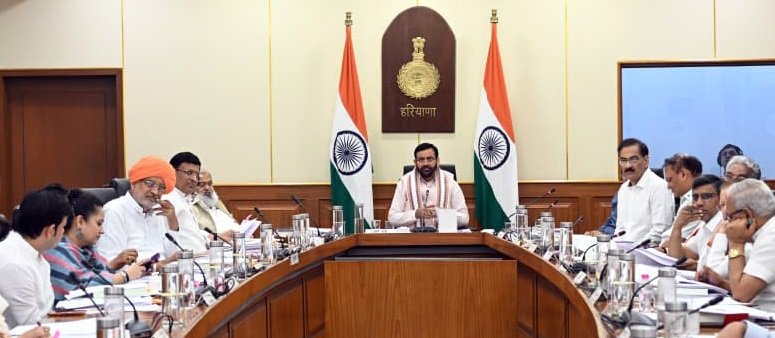
The Haryana Cabinet which met under the Chairmanship of Chief Minister Sh. Nayab Singh Saini here today has approved the Model Online Transfer Policy (MOTP), 2026 and the Teachers Transfer Policy (TTP), 2026, with the objective of ensuring optimal utilization of human resources, promoting employee satisfaction, enhancing administrative efficiency and strengthening public service delivery in the larger public interest.
The revised policies have been formulated after due consideration of the observations of the Hon’ble Punjab and Haryana High Court as well as feedback received from various stakeholders.
The Hon’ble Court had, inter alia, expressed concerns including weightage assigned to age, low merit points accorded to couple cases etc under the previous transfer framework. Accordingly, the policy framework has been comprehensively reviewed to address these concerns while incorporating stakeholder feedback.
Under the new policies, employee ranking for transfer purposes shall be determined through a revised 120-point composite scoring framework. The weightage assigned to age has been reduced from 75% to 25%. To recognize professional experience and service continuity, a new parameter, “Experience in Cadre,” has been introduced, carrying 25% weightage. Further, the weightage allocated to Special Factors has been enhanced from 25% to 50%, thereby providing greater consideration to employees facing genuine hardships and special circumstances.
In a significant expansion of employee welfare provisions, the list of recognized debilitating diseases has been broadened to include Muscular Dystrophy, Behçet Disease, and specified organ transplant cases such as pancreas and bone marrow transplants. Further, the policies also introduce an important safeguard whereby no employee or teacher within one year of superannuation shall be transferred without his or her explicit written consent.
Support for regular government-serving couples has been further strengthened. The merit points available under the couple case category have been increased from 5 to 10 points. Additionally, the definition of eligible “Organizations” has been expanded to include regular employees of any Government, provided they are posted in Haryana, Chandigarh, or Delhi.
To improve procedural efficiency and transparency, the policies provide for streamlined timelines and introduce the concept of “Category”, enabling a clearer distinction between participating and non-participating employees during transfer drives.
With the notification of these policies, any transfer drives initiated under the provisions of the Model Online Transfer Policy, 2025 and Teachers Transfer Policy, 2025 shall stand discontinued, ensuring that all eligible employees benefit from the fairer and more balanced criteria established under the 2026 policy frameworks.
The Cabinet has further authorized the Human Resources Department to issue necessary instructions regarding the first online transfer drive under MOTP, 2026, particularly in respect of the Notional Category and cadres where Current Duty Charge (CDC) arrangements are in operation.
These reformulated policies reaffirm the State Government’s commitment to a fair, transparent, objective, and technology-driven transfer mechanism, while ensuring administrative efficiency and employee welfare.
ACCORDED APPROVAL AMENDMENT IN DAYALU-I
Cabinet ccorded approval to a proposal regarding Amendment in DeenDayal Upadhyay AntyodyayParivar Suraksha Yojana (DAYALU-I) Scheme of Haryana Parivar Suraksha Nyas (HPSN).
The amendments include extension of claim submission window from 3 months to 6 months and Retrospective Relief, Tiered Delay condonation Mechanism Proposal, Grievance Redressal Mechanism.
Extension of Claim Submission Window and Retrospective Relief: Extension of claims Submission Window and Retrospective Relief Extension of claim filling period from 3 months to 6 months from the date of death/disability for all future claims and Three-month retrospective relaxation for all claims filed till date (i.e., upto 6 months from Date of Death/disability).
Tiered Delay Condonation Mechanism: A Tiered delay condonation mechanism with delegated powers as follows for all future claims, ie. CEO-HPSN, for delays beyond 6 months and upto 7months, ACS/ Finance, for delays beyond 7months and upto 9 months and Finance Minister, for delays beyond 9 months and upto 12 months.
Grievance Redressal Mechanism: A Structured Grievance Redressal Mechanism will be established wherein Deputy Commissioner (DCs) shall act as field- level authorities and District Statistical officers (Dsos) of DESA to function as nodal officers of DAYALU-I scheme at the district level, In addition to existing HQ level officers.
Cabinet approved grant of exemption in Motor Vehicle tax
Cabinet approved grant of exemption in the Motor Vehicles Tax for replacement of old trucks and buses (BS-IV or prior emission norms) in the NCR districts of the State as per scheme for support to National Capital Region Planning Board.
A 100 percent motor vehicle tax concession will be given on the purchase of new BS-VI or stricter norms, EV, CNG trucks and buses to eligible beneficiaries under the new scheme for trucks and buses.
Furthermore, a 50 percent motor vehicle tax concession will be granted on purchase of used BS-VI or stricter norms, EV, CNG trucks and buses to eligible beneficiaries under the new scheme for trucks and buses. In both cases, the motor vehicle tax concession will be valid for a period of 10 years.
Besides this, Waiver of Registration fees will also be granted on the registration of new vehicles purchased under the scheme, and lastly, the beneficiaries participating in the Scheme with old trucks and buses will receive a waiver of liabilities pending for more than one year.
Notably, the Governor of Haryana has further exempted the outstanding liability, pending for more than one year, in respect of old BS-IV or prior emission norms compliant trucks and buses registered in the NCR districts of the State of Haryana.
The said incentive is expected to accelerate fleet modernization, reduce vehicular emissions, and improve air quality in the NCR districts of the State for 93,458 trucks and 16,329 buses.
CABINET APPROVED HARYANA HORTICULTURE NURSERIES ACT 2025
Cabinet approved the Haryana Horticulture Nurseries Rules, 2026 under Section 22(1) of the Haryana Horticulture Nurseries Act, 2025 (Haryana Act No. 17 of 2025).
The newly approved Haryana Horticulture Nurseries Rules, 2026 provide a complete regulatory system for the management and monitoring of Horticulture Nurseries in the State.
The Rules specify the process for applying, granting, renewing, and adding categories in nursery licences. They also define minimum nursery standards, recordkeeping, and QR-based disclosure of the planting material being sold.
The Rules shall apply to horticulture nurseries dealing with fruit plants, vegetables, tubers, spices, condiments, flowers, ornamental plants, medicinal and aromatic crops, and such other plants as may be declared by the Government, by notification, to be horticulture plants. The Rules aim to ensure the production and availability of quality planting material across all major horticultural crops in the State.
The True to type plants shall be made available to farmers.Such plants shall be disease/ nematode free plants.There is a provision to provide compensation to farmers to the tune of twice of cost of cultivation in case the seller (nursery) sold poor quality or ‘substandard or‘not true to type’ plants to the purchaser.
The Rules further provide for regular inspection of nurseries, action in case of violation including suspension or cancellation of licences, and compulsory destruction of infected or illegal planting stock to prevent spread of pests and diseases. A time-bound appeal system has been proposed so that grievances can be resolved quickly.
The Rules are essential for enforcement of the Act and for ensuring availability of quality planting material, maintaining accountability in nursery operations, preventing spread of pest-borne diseases through seedlings, and safeguarding the interests of farmers and purchasers.
APPROVED URBAN LOCAL BODIES DEPTT.PROMULGATE
Approved the proposal of the Urban Local Bodies Department to promulgate the Haryana Municipal Corporation (Amendment) Ordinance, 2026, as the State Legislature is not currently in session.
The Cabinet approved amendments to sub-section (1) of Section 200 of the Haryana Municipal Act, 1973, and sub-section (1) of Section 329 of the Haryana Municipal Corporation Act, 1994. Through these amendments, the provision relating to dual licensing will be removed in compliance with the directions of the Deregulation Cell, Government of India, which has advocated the elimination of dual licences in the public interest.
Consequently, the requirement of obtaining trade licences for slaughterhouses and meat shops will be discontinued, as these establishments are already regulated by the Food & Drugs Administration, Haryana. The move aims to eliminate duplication in the licensing process, reduce regulatory burden on businesses, and promote ease of doing business in the state.
Cabinet Approves Amendments to Haryana Superior Judicial Service Rules, 2007
Haryana Cabinet approved amendments to the Haryana Superior Judicial Service Rules, 2007, in compliance with the judgment dated May 19, 2023, passed by the Hon’ble Supreme Court of India in the matter of All India Judges Association versus Union of India and Others.
The amendments have been proposed by the Punjab and Haryana High Court to align the State’s judicial service rules with the directions issued by the Supreme Court regarding service conditions and career progression of officers of the Higher Judicial Service.
Under the approved amendments, changes have been made in Rules 16(1), 16(2) and 17 of the Haryana Superior Judicial Service Rules, 2007. In addition, a new Appendix has been inserted and consequential amendments have been carried out in the Schedule attached to the Rules.
The amendments provide for the adoption of a revised pay structure for members of the Haryana Superior Judicial Service. The revised provisions incorporate the pay scales and annual progression for District Judges at Entry Level, Selection Grade and Super Time Scale, as recommended in accordance with the directions of the Hon’ble Supreme Court.
The Cabinet also approved provisions relating to the grant of Selection Grade and Super Time Scale posts. As per the amended rules, Selection Grade shall be available to 35 percent of the cadre posts of District Judges and will be granted to officers having not less than five years of continuous service in the cadre on the basis of merit-cum-seniority.
Similarly, Super Time Scale shall be available to 15 percent of the cadre posts of District Judges and will be granted to officers who have completed not less than three years of continuous service in Selection Grade, subject to assessment on the basis of merit-cum-seniority.
The amended provisions further stipulate that annual increments shall be calculated at the rate of three percent on a cumulative basis, with each year’s increment being computed on the previous year’s basic pay.
Haryana Cabinet Approves Adoption of Water (Prevention and Control of Pollution) Amendment Act, 2024: Cabinet, approved the proposal to adopt the Water (Prevention and Control of Pollution) Amendment Act, 2024 (Central Act 5 of 2024), paving the way for bringing the amended central legislation into force in the state.The Water (Prevention and Control of Pollution) Amendment Act, 2024 was enacted by Parliament and notified by the Ministry of Environment, Forest and Climate Change on February 15, 2024. The amendment seeks to decriminalize and rationalize minor offences under the Water (Prevention and Control of Pollution) Act, 1974, with the objective of promoting trust-based governance, improving ease of living and facilitating ease of doing business. The amended law also streamlines the process for nomination of Chairpersons of State Pollution Control Boards.
The Amendment Act initially became applicable to the states of Himachal Pradesh and Rajasthan, which had passed resolutions for its adoption. Other states can adopt the Act by passing a resolution through their respective legislatures.
With the Cabinet’s approval, Haryana will now move a resolution in the State Legislative Assembly for adoption of the Water (Prevention and Control of Pollution) Amendment Act, 2024, making its provisions applicable in the state.
The adoption of the amended law will help modernize the regulatory framework governing water pollution control by replacing criminal penalties for minor procedural violations with a more balanced and compliance-oriented approach.
Cabinet approved amendment in the Haryana Village Common Lands (Regulation) Act, 1961 : Cabinet approved amendment in the Haryana Village Common Lands (Regulation) Act, 1961 by issuance of Haryana Village Common Lands (Regulation) Ordinance, 2026. At present existing provisions of the Act, the Director, Development and Panchayats Department, Haryana, is empowered to accord approval to Gram Panchayats for the sale of shamilatdeh land to eligible applicants who had constructed their houses on such land on or presently before March 31, 2004.
A large number of applications are pending at various levels and are awaiting approval. In order to expedite the process of disposal of such cases and provide timely relief to eligible applicants, the Government has delegated the power of granting approval to the concerned District Deputy Commissioner.
*Approved promulgation of the Haryana State Commission for Women (Amendment) Ordinance, 2026 for amendment of Section 3(2)(b) of the Haryana State Commission for Women Act, 2012 (Haryana Act No. 27 of 2012) to increase the number of non-official Members of the Haryana State Commission for Women from five to seven.
Notably, due to enhanced legal awareness, improved accessibility, and increased public confidence, the number of complaints and representations received by the Commission has risen substantially in recent years. As a result, the workload and responsibilities of the Commission have expanded significantly, especially in cases related to domestic violence, sexual harassment, cybercrime, and other women-related issues.
The present strength of five non-official Members prescribed under Section 3(2)(b) of the Haryana State Commission for Women Act, 2012 has become inadequate to effectively discharge the statutory responsibilities entrusted to the Commission. Therefore, in order to augment the institutional capacity of the Commission and ensure expeditious disposal of complaints, wider representation and effective discharge of its statutory functions, the maximum number of non-official Members have been increased from five to seven by amending Section 3(2)(b) of the Haryana State Commission for Women Act, 2012.
*Approved a proposal to issue directions regarding colonies falling under the Municipal Council, Yamuna Nagar, and Municipal Council, Jagadhari, where buildings were regularised by the Government in 1996.The issue came to light during 2021-22 when the Urban Local Bodies Department introduced an online No Dues Certificate (NDC) portal integrated with GIS-mapped property data. The inclusion of any approved area in the digital portal requires clearly defined geo-referenced boundaries. However, colonies regularised before 2005 lacked authentic layout plans and details of Khasra numbers, making it impossible to accurately map their boundaries on the GIS platform. As a result, vacant or unmapped plots within these colonies were automatically classified as “unapproved” by the system.
Consequently, properties regularised prior to 2004 in areas notified under Section 203A have been facing several challenges. The absence of clearly demarcated boundaries for these colonies has hindered development works, while property IDs could not be integrated with the NDC portal. This has led to difficulties in obtaining building plan approvals and carrying out property sale and purchase transactions.
To address these issues, the Cabinet has approved the issuance of directions to the Director, Urban Local Bodies, to constitute a committee at the Municipal Corporation, Yamuna Nagar. The committee will be chaired by the Commissioner and will include the Chief Town Planner or District Town Planner, Chief Engineer or Superintendent Engineer of the Municipal Corporation, Additional Municipal Commissioner/Joint Commissioner/Executive Officer, Mayor’s nominee, Executive Engineer, Revenue Officer, and Zonal Taxation Officer as members.
The committee will identify colonies where buildings were regularised under Section 203A and notified through Official Gazette notifications or formal Government Orders before the enactment of the Haryana Management of Civic Amenities and Infrastructure Deficient Municipal Areas Act, 2013, on September 26, 2013. These are colonies for which neither Khasra number details nor approved layout plans are available.
The committee will prepare and finalise proposals for such colonies and draw outer boundary lines enclosing the areas where buildings had been regularised. This exercise will facilitate the integration of property records with the NDC portal and enable planned development in these areas.
The Cabinet also approved provisions regarding payment of development charges. Property owners who had constructed buildings on or before the date of notification of the colony in 1996 but had not paid development charges earlier will be required to pay the charges applicable at the time of notification. Owners who have already paid the requisite development charges will be required to submit proof of payment to avail a waiver of the charges reflected on the portal.
Haryana
Trending
CABINET APPROVES MODEL ONLINE TRANSFER POLICY, 2026 AND TEACHERS TRANSFER POLICY, 2026