Face2News/Chandigarh
The Solar Energy Vendors Association (SEVA), Punjab, has urged the Central Government and the Ministry of New and Renewable Energy (MNRE) to reconsider the decision to make Domestic Content Requirement (DCR) solar panels mandatory under the Approved List of Models and Manufacturers (ALMM)-2 and to defer its implementation.
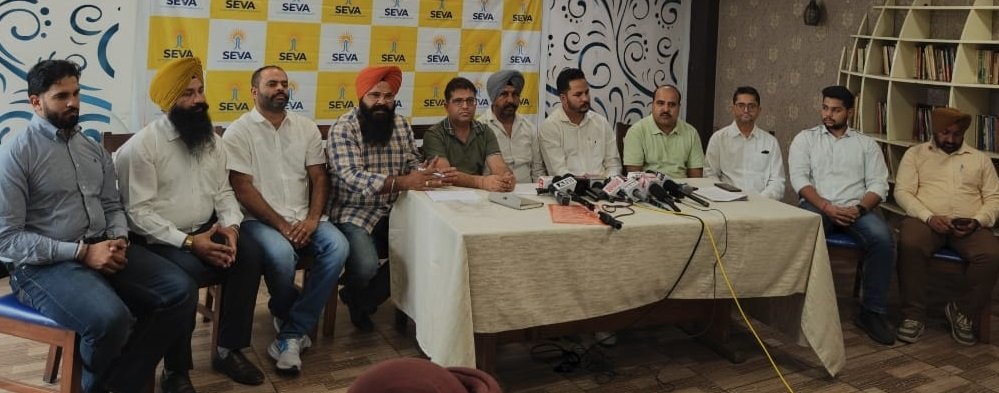
The Association held a press conference today at the Chandigarh Press Club regarding the mandatory implementation of the ALMM policy and DCR panel requirements introduced by the Central Government. Association office-bearers Khushwinder Singh Brar and Gurinder Singh Brar stated that while the government’s decision to promote domestic solar cell and panel manufacturing is understandable, making it mandatory without considering ground realities has thrown the entire solar sector into difficulty.
During the press conference, SEVA President Sukhpal Singh and other office-bearers, including Amit Khurana, Sangram Singh, Balwinder Singh Virk, Gurinder Lohara, and Saksham Verma, said that the mandatory implementation of DCR norms and ALMM-2 List-I compliance is having a significant impact on the solar industry and consumers across Punjab and the country.
According to them, these stringent regulations are affecting project costs, equipment availability, and consumer affordability. Earlier, a standard 3 kW non-DCR solar system could be installed for approximately ₹1.5 lakh. However, a fully ALMM-compliant and DCR-certified 3 kW system now costs between ₹1.8 lakh and ₹2.1 lakh.
The Association said it supports the objective of strengthening domestic manufacturing and making India self-reliant in renewable energy. However, under the current circumstances, the implementation of the policy is creating serious challenges for the solar industry.
Association representatives pointed out that the price difference between DCR and non-DCR panels has now increased to ₹10,000–14,000 per kW, compared to only around ₹2,000 per kW in 2020. This has caused a sudden rise in project costs and made solar installations significantly more expensive for consumers.
For a typical household, a 3 kW solar system has become nearly ₹30,000 more expensive, placing an additional financial burden on consumers.
They further stated that although the government is providing substantial subsidies, consumers can avail themselves of these benefits only if they install fully ALMM-2 List-I certified Indian-made panels, which are comparatively more expensive. The policy is expected to have the greatest impact on captive and net-metering projects installed on factories, shopping malls, hospitals, and large industrial rooftops.
The Association noted that thousands of solar projects had been approved and planned based on the pricing of non-DCR panels. Due to the sudden increase in costs, solar vendors are facing financial and operational difficulties in executing these projects. At the same time, many consumers are postponing or cancelling their planned installations.
Office-bearers also highlighted the inadequate availability of DCR panels in the market, resulting in project delays. They alleged that the current situation could primarily benefit a few large domestic manufacturers, while the lack of competition may lead to further price increases.
The Association warned that if project costs continue to rise and supply shortages persist, the adoption of solar energy across residential, commercial, and industrial sectors could slow down significantly, potentially affecting India’s renewable energy targets.
SEVA urged the Central Government and MNRE to ensure adequate availability of DCR panels nationwide, regulate prices, introduce a transparent pricing mechanism, and provide financial support and subsidies for all categories of solar projects. The Association also requested a reasonable transition period for projects that had already been approved before the policy came into force.
During the press conference, issues specific to Punjab were also raised. The Association stated that the new software recently introduced by Punjab State Power Corporation Limited (PSPCL) has caused delays in approvals, feasibility reports, completion certifications, meter installations, load enhancement approvals, and consumer name-change processes related to solar projects. Additionally, shortages of energy meters within power distribution companies are adversely affecting project implementation.
The Association appealed to the Central Government and concerned departments to engage in dialogue with industry representatives and address these issues at the earliest, so that consumer interests can be protected, domestic manufacturing can be encouraged, and the momentum of India’s renewable energy mission can be maintained.