FAZILKA, TERMINUS OF THE TAPI GAS PIPELINE, MUST NOT SLIP OFF THE MAP, SAYS FORMER SPECIAL CHIEF SECRETARY
Face2News/Chandigarh
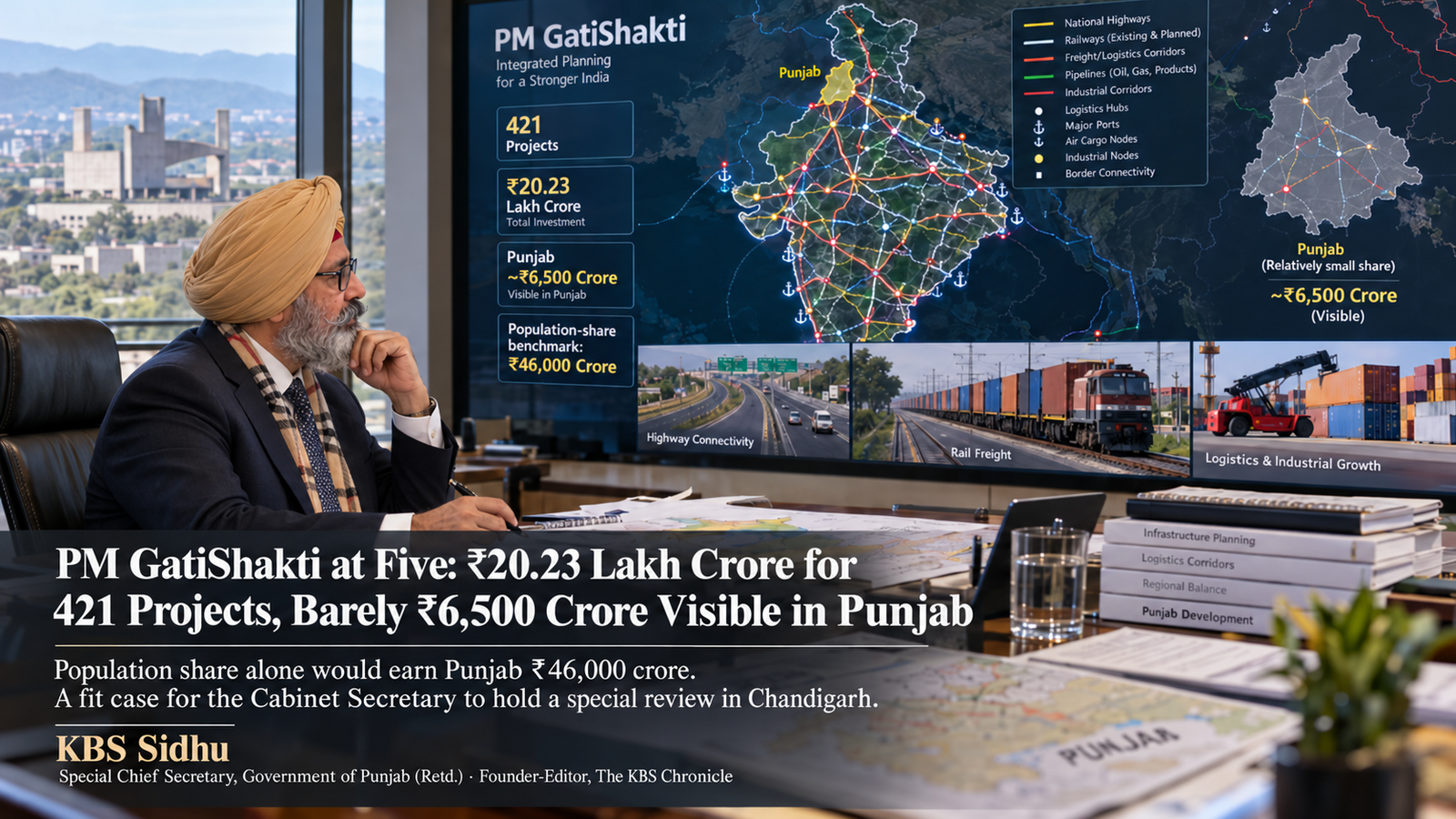
Only three of the 421 infrastructure projects evaluated in five years of PM GatiShakti can be traced to Punjab in the public record, and all three are still at an early stage, according to KBS Sidhu, retired Special Chief Secretary, Government of Punjab.
The Union Ministry of Commerce and Industry announced on 13 October that the Network Planning Group had evaluated 421 projects with an estimated value of about ₹20.23 lakh crore, and that its geospatial platform now integrates more than 1,800 data layers. KBS Sidhu points out that the figure equals about 5.8 per cent of India’s 2025-26 nominal GDP of ₹346.36 lakh crore, but that it measures projects evaluated, not money sanctioned or spent. By August 2026, 256 of the 396 projects then evaluated had been sanctioned, and 198 were under implementation.
In a D.O. letter dated 15 October to Cabinet Secretary Dr T.V. Somanathan, who chairs the Empowered Group of Secretaries overseeing GatiShakti, KBS Sidhu has noted that the Ministry’s release carries no State-wise break-up. He has enclosed an annexure of Punjab projects dug out from the public domain:
▪ The Sirhind–Sehna section of NH-205AG (₹4,598 crore) was evaluated in March 2025 and still awaits Cabinet approval.
▪ The Zirakpur Bypass was evaluated at the same meeting and awarded only in March 2026.
▪ The Ambala–Jalandhar third and fourth rail lines were evaluated in September 2025, with no sanction reported.
▪ NHAI terminated three Punjab packages of the Delhi–Amritsar–Katra Expressway in May 2026, and the project’s cost has risen from ₹25,000 crore to ₹38,905 crore.
▪ Of 714 km of railway works sanctioned for Punjab, only 115 km had been commissioned by April 2025; the Firozpur–Patti line still awaits 166 hectares of land.“In nearly every case, the delay comes down to land, and the knots sit in the tehsil and the Deputy Commissioner’s office,” said KBS Sidhu, who served twice as Financial Commissioner Revenue, Punjab. “They loosen fastest when the Centre and the State sit at the same table, with the revenue machinery in the room.”He has, therefore, asked the Cabinet Secretary to chair a special Punjab-specific review at Chandigarh, with the concerned Union Secretaries, the Chairman of NHAI, the Chief Secretary, Punjab, and the Deputy Commissioners of the affected districts. He wants a consolidated project-wise statement for Punjab placed before that meeting and thenmade public.
TAPI: Fazilka Must Stay on the MapThe letter gives a separate paragraph to the Turkmenistan–Afghanistan–Pakistan–India (TAPI) gas pipeline, whose designated terminus is Fazilka. The Turkmen section was completed in 2024, and construction in Afghanistan has been under way since September 2024. At the Indian end, nothing visible has moved.
KBS Sidhu accepts that, given the present state of relations with Pakistan, transit through that country may not be realistic for some time. He has asked the Government of India for a clear view on India’s continuing participation through GAIL, so that Punjab can plan. He has also proposed that the Fazilka terminal site and a pipeline corridor be protected as a layer on the GatiShakti platform, and that the border districts be brought onto the national gas grid through domestic and LNG-fed supply in the meantime.“Fazilka was chosen as the gateway for Central Asian gas. That decision should not quietly lapse because the pipeline is held up beyond our borders,” KBS Sidhu said.
A Due Share, and More
KBS Sidhu argues that Punjab should receive not merely its proportionate share of the national pipeline but rather more, as a border State which, in his view, has been neglected in public sector investment in the past. “A border State’s roads, railway lines and pipelines are part of the nation’s defences as much as its economy,” he said.
A copy of the letter has been sent to the Chief Secretary, Punjab, with a request to have the State’s land position ready for the review. KBS Sidhu has written in his individual capacity